
Why does AI give confidently wrong answers about your business data?
AI assistants answer from whatever tables they can see and can't tell which revenue number is right. The fix is mostly data engineering: one tested definition per metric, reconciled gold tables, pipelines that stop on bad data, and written-down context for whichever AI assistant reads it.
AI gives confidently wrong answers about business data because it answers from whatever tables and column names it can see, and it has no way of knowing which revenue number is the right one. Most of the fix sits upstream of the AI: one tested definition per metric, data that is reconciled before anyone relies on it, and a semantic model that tells the assistant what things mean.
What “confidently wrong” looks like
Ask an assistant what revenue was last quarter and you get a number in a few seconds, formatted nicely, with a sentence explaining it. It reads like an analyst’s answer. Whether it is right depends on things the assistant can’t see:
- Which table it picked. If gross charges, billed revenue and collected cash all live in tables with “revenue” somewhere in the name, it chooses one.
- Which date it filtered on. Service date, invoice date and posting date give you three different quarters.
- What should have been excluded. Voided invoices, test accounts, intercompany transfers. These rules usually live in someone’s head, or in a filter pane nobody has opened since 2021.
- Whether last night’s load finished.
A new analyst would ask. A model usually doesn’t. It picks the most plausible reading and states it with the same confidence it uses for a correct answer, so the wrong answer and the right answer look identical. A junior analyst at least looks nervous.
Most of the fix is upstream of the AI
Most companies we meet already have this problem without any AI involved. Two reports show different revenue for the same month and nobody can say which is right. That was the starting point when we moved about 80 Power BI Pro reports to a governed Fabric platform for an online education provider (case study). An assistant sitting on top of those 80 reports would not have settled the disagreement. It would have picked a side, faster.
Better prompts help at the margin. What changes accuracy is what the model reads.
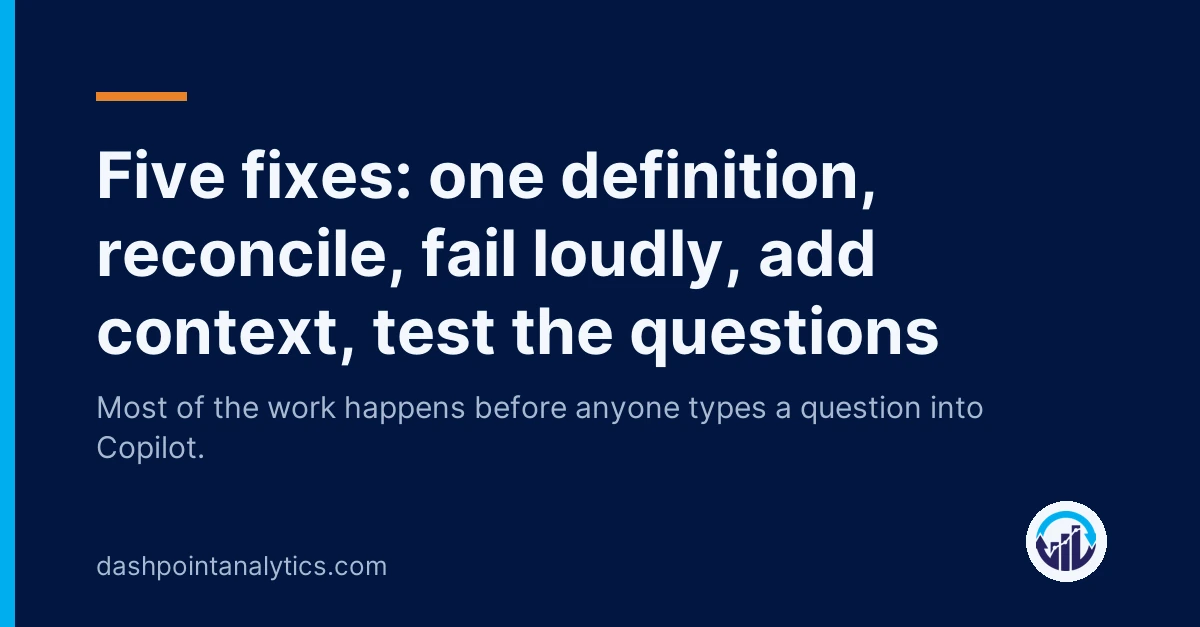
Five things that fix it
1. One definition per metric, built once
In a medallion lakehouse, business rules are applied once, in the silver and gold layers, in code that lives in Git. The gold table answers “what counts as revenue” so that neither the report nor the assistant has to guess. If there is one revenue table, the assistant can’t pick the wrong one.
2. Reconcile before anyone asks the AI anything
We reconcile gold totals against the old system before cutover. On a healthcare revenue cycle platform (case study), gold totals reconcile to the legacy system within about 1%. That step is what makes the number the assistant reads worth trusting. Skip it and you have automated an unverified number.
3. Fail loudly when the data is bad
A pipeline that fails is annoying. A pipeline that succeeds with bad data is worse, because the assistant will quote it with full confidence. The education platform’s nightly pipeline has a circuit breaker: checks run on silver before gold is touched, and if they fail, gold keeps the last good load. An assistant reading yesterday’s correct numbers, with a visible refresh date, beats one reading today’s broken ones.
4. Give the AI the context an analyst would ask for
Any assistant, whether it’s Copilot, ChatGPT, Claude or an agent your team built on the SQL endpoint, needs what a new analyst would ask for: which tables to use, what the columns mean and which business rules apply. Give it a curated set of gold tables or views instead of the whole lakehouse, a description on every table, column and measure, and the business rules written in plain language next to the data. Write that context once, where the data lives, and every tool you try later reads the same rules.
If you are on Power BI, Microsoft has built a version of this into the semantic model. Prep data for AI, currently in preview, works on the semantic model and has three parts:
- AI data schema: limit which tables and columns the assistant considers. Leave out the staging tables and the three retired revenue columns.
- Verified answers: tie common questions to a visual you have checked, so “revenue last quarter” returns the approved answer.
- AI instructions: business rules in plain language, such as which date revenue is reported on by default.
Microsoft recommends that order: schema first, verified answers next, instructions last for fine tuning. That order makes sense. Instructions patch a messy model; a clean schema means there is less to patch. Add descriptions to tables, columns and measures while you are there, and only mark the model “approved for Copilot” once it passes the next step.
5. Test the assistant the way you would test a report
Write down 20 or 30 questions finance and operations actually ask, with the reconciled answers, and rerun them after every model or pipeline change. If an answer drifts, you find out before the CFO does.
The same discipline applies to machine learning. On a payer pricing model (case study) we removed a leaky feature, which made the model’s score worse and its predictions honest. A score that looks great because the model can see the answer is another form of confidently wrong.
Where AI does help analysts
None of this means analysts should avoid AI. It is useful for drafting SQL and DAX, explaining what an inherited measure does, first-pass exploration of a new table, and writing up variance commentary. In all of those, a person checks the output before it goes anywhere.
The practical rule: treat the assistant as a fast new hire with no institutional memory. It will do a lot of work quickly, and it will not know that the March numbers were restated unless something tells it.
Where to start
If there is an AI assistant in your 2027 plans, start with an inventory: which metrics have more than one definition today, where each one is calculated, and whether anyone reconciles them. That list tells you how much data engineering stands between you and answers you can trust.
That inventory is part of our short Fabric assessment, along with your sources, the capacity you would need and a build plan with costs. Get in touch if you want one.